
Protein Grams to Calories: Formula, Chart and Label Examples
To convert protein grams to calories, multiply the grams of protein by four.
For example:
25 g protein × 4 = about 100 calories from protein
The last three words matter. That is the energy attributed to the protein—not necessarily the total calories in the food or meal.
A serving can contain protein, carbohydrate and fat together. And a food portion that weighs 100 grams does not automatically contain 100 grams of protein.
The protein-to-calorie formula
The standard conversion is:
Calories from protein = protein grams × 4
USDA’s Food and Nutrition Information Center lists protein at 4 calories per gram, carbohydrate at 4 and fat at 9. This is a practical conversion factor, not a measurement of a particular person’s response to a meal.
Source: USDA Food and Nutrition Information Center
To work backward:
Protein grams = calories from protein ÷ 4
For example, 120 calories specifically attributed to protein corresponds to:
120 ÷ 4 = 30 g protein
You cannot use a food’s total calories in that reverse calculation unless you know those calories all come from protein.
Protein grams to calories: quick chart
| Protein amount | Approximate calories from protein |
|---|---|
| 10 g | 40 |
| 20 g | 80 |
| 25 g | 100 |
| 30 g | 120 |
| 40 g | 160 |
| 50 g | 200 |
| 100 g | 400 |
These are conversion examples, not recommended serving sizes or daily targets. The calculation does not establish how much protein any individual needs.
Why 25 grams of protein can appear in a 200-calorie food
Imagine a hypothetical label showing:
- Calories: 200 per serving
- Protein: 25 g per serving
The protein contributes approximately:
25 × 4 = 100 calories
That leaves approximately 100 calories attributed to other components and any differences involved in the label’s calculation and rounding.
There is no contradiction. Protein is part of the total, not an additional amount to add on top.
The FDA explains that the Calories line includes energy from all sources in the serving, including protein, carbohydrate, fat and alcohol.
Source: FDA — Calories on the Nutrition Facts Label
If a food’s label already says 200 calories, do not log 200 plus another 100 for its protein. That would count the protein contribution twice.
What percentage of calories comes from protein?
For the same hypothetical serving:
100 protein calories ÷ 200 total calories × 100 = 50%
This is a percentage of energy—not a percentage of the food’s weight, and not the label’s percent Daily Value.
Two foods could each provide 25 g of protein but have different total calories. Their protein-calorie percentages would then differ even though their protein amounts match.
Adjust for the amount actually eaten
Suppose a hypothetical label lists 20 g protein per serving, and the portion is 1½ servings.
First calculate the protein amount:
20 × 1.5 = 30 g protein
Then convert:
30 × 4 = 120 calories from protein
You can also multiply in the other order:
20 × 4 × 1.5 = 120
The result is the same because the serving adjustment applies to the entire calculation.
FDA notes that nutrition information is usually listed per serving, although some packages also show per-package information. A listed serving size is not an instruction about how much a person should eat.
Source: FDA — Serving Size on the Nutrition Facts Label
Before calculating, identify whether the label refers to one serving, the whole package or another stated quantity.
Food weight is not protein weight
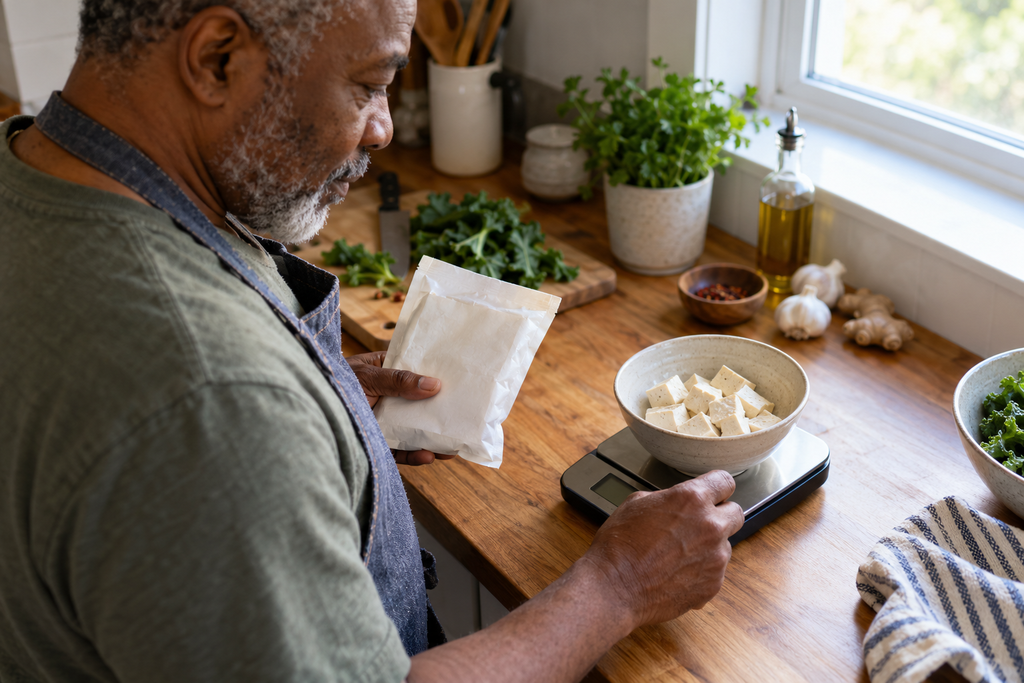
A kitchen scale weighs the whole food portion. It does not separate the portion into protein, water, carbohydrate, fat and other components.
For example, suppose a hypothetical food provides 12 g protein per 100 g of food. A 150 g portion contains:
150 ÷ 100 × 12 = 18 g protein
Its protein contribution is:
18 × 4 = 72 calories
Multiplying the food weight itself by four would instead produce 600 calories. That would incorrectly treat all 150 g as protein.
The same distinction applies to protein powder. A 30 g scoop is 30 g of product; look at the label to find the protein contained in that scoop.
Match the food’s preparation state
If using a database entry rather than a package label, check that it describes the food as weighed—for example, cooked rather than dry.
Otherwise, the portion weight and the nutrient entry may describe different things. The multiplication can be correct while the starting information is mismatched.
Why reconstructed calories may not match the label exactly
A common cross-check multiplies protein and carbohydrate grams by four and fat grams by nine.
For a hypothetical serving containing 25 g protein, 18 g carbohydrate and 7 g fat:
25 × 4 + 18 × 4 + 7 × 9 = 235 calories
That is a useful arithmetic check, not a guarantee that every label must display exactly 235.
FDA’s labeling guidance describes rounding conventions and multiple approaches to calculating calorie values. A calculation using rounded displayed grams can differ from one using the underlying values. Some ingredients also require factors beyond a simple three-macronutrient shortcut.
Source: FDA — Food Labeling Guide, calorie calculation and rounding sections
A mismatch is a reason to inspect the serving basis and ingredients—not enough information by itself to declare the label wrong.
What the site’s macro calculator adds
For a single protein amount, multiplying by four is enough.
The macro calculator answers a broader arithmetic question: it divides a daily calorie input into protein, carbohydrate and fat amounts using the selected split. It also asks for meals per day.
Its protein conversion uses the same four-calorie factor explained here. But a split chosen in a calculator is still an assumption, not a personalized requirement.
Without a daily calorie input and the other selections, there is no complete calculator output to report.
Frequently asked questions
How many calories are in 100 grams of protein?
Using the standard factor, 100 g of protein contributes approximately 400 calories. That does not mean a 100 g portion of a protein-containing food has 400 calories.
Does 30 grams of protein mean 120 total calories?
It means approximately 120 calories from protein. The food’s total may also include energy from other components.
Are kcal and food Calories different units?
On nutrition labels, a food Calorie means a kilocalorie, abbreviated kcal. In this article, “calories” follows that everyday food-label usage.
Can I calculate protein grams from total calories alone?
Not for a mixed food. You need to know the calories specifically attributed to protein, or use the protein grams stated on the label.
Try the relevant tool
Use the macro calculator to explore the arithmetic behind a selected calorie split, or browse all calculators for other measurement questions.
The key distinction is simple: protein grams describe an amount of one nutrient; total calories describe energy from the whole serving.
General educational information only. These calculations explain conversions and labels; they are not individualized nutrition or medical advice.